
Smartphone customization is not limited to changing wallpapers, icons, and home screen layouts. You can also experiment with different ways of interacting with your phone. A Gesture Lock Screen app is one interesting option for Android users who want to explore gesture-based controls and personalize their smartphone experience.
Most Android smartphones come with a traditional lock screen that uses a PIN, password, pattern, fingerprint, or face authentication. While these options provide essential security, some users enjoy trying alternative interfaces that offer additional visual customization and touch-based interactions.
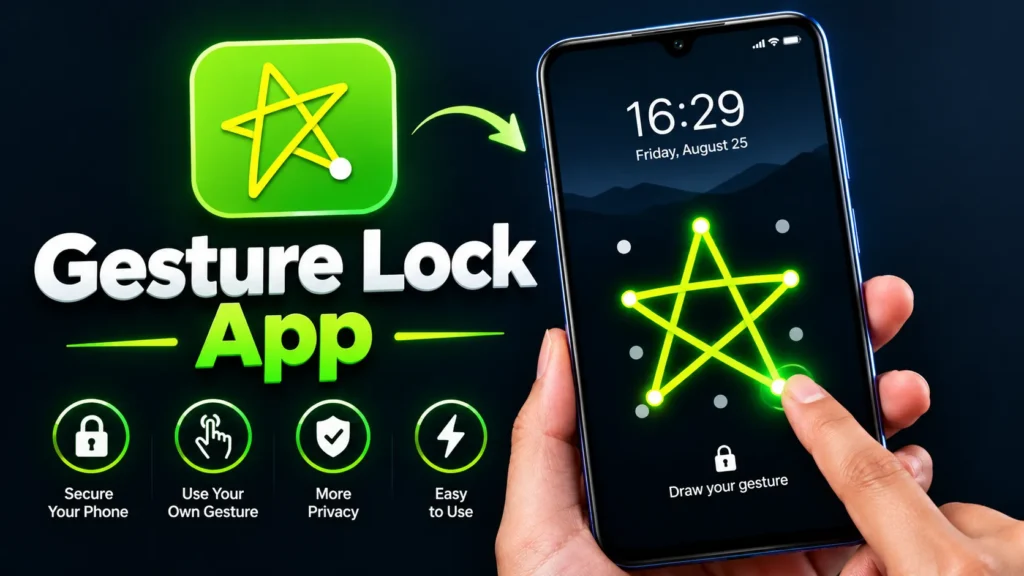
A gesture lock screen application may allow you to draw specific shapes, configure touch movements, or access supported shortcuts. Depending on the application, you might also find options to change the lock screen background, clock appearance, and other visual elements.
In this article, we will explore how gesture lock screen apps work, their features, customization options, installation process, and important things to consider before using one.
What Is a Gesture Lock Screen App?
A Gesture Lock Screen app is an Android application that introduces gesture-based interactions to your smartphone. Instead of relying only on traditional buttons, these applications may let you perform certain actions using predefined touch movements.
For example, an application might allow you to draw a particular shape to open a shortcut or use a specific swipe gesture to perform an assigned action.
Some applications concentrate on providing a customized lock screen appearance, while others focus on gesture shortcuts and touch controls. The available features depend on the developer and the Android version running on your device.
It is important to understand that not every gesture lock screen application replaces the original Android lock screen. Some applications provide a visual interface on top of the existing system, while others offer shortcuts that work only when the device is unlocked.
Therefore, check the application’s description carefully to understand whether it provides actual device authentication or simply offers gesture-based customization.
Main Features of a Gesture Lock Screen App
The biggest attraction of gesture lock screen applications is their ability to provide a different smartphone experience. Here are some features you may find in these applications.
1. Create Custom Gestures
Custom gestures are one of the main features associated with this category of applications.
Depending on the app, you may be able to configure different movements, such as drawing a circle, creating a line, or swiping in a particular direction.
These gestures can sometimes be assigned to specific actions. For example, you might configure a gesture to open a supported application, access a shortcut, or activate a particular function.
The available gesture options vary between applications. Some provide only a few predefined movements, while others offer additional customization settings.
2. Personalize the Lock Screen Appearance
A traditional lock screen may look similar every day unless your smartphone manufacturer provides customization options.
Some gesture lock screen applications offer additional visual settings that allow you to change the overall appearance.
Depending on the application, you may find options for:
- Changing the lock screen wallpaper.
- Selecting different clock styles.
- Adjusting colors and visual elements.
- Customizing the appearance of gesture indicators.
- Choosing different interface layouts.
- Matching the screen with your smartphone theme.
These options can help you create a more personalized smartphone interface without changing your entire launcher.
3. Gesture-Based App Shortcuts
Another useful feature available in some gesture applications is the ability to assign actions to particular movements.
For example, you might want to access your camera frequently. If the application supports app shortcuts, you may be able to assign a gesture to launch it.
Similarly, other supported applications can be assigned to different gestures.
This feature can be useful for people who frequently switch between applications. However, remember that shortcuts may work only when the phone is unlocked or when the application is running.
4. Adjust Gesture Sensitivity
Some applications provide settings for adjusting how gestures are detected.
Gesture sensitivity can influence how accurately an application recognizes your touch movements. If the sensitivity is too high, accidental movements might trigger unwanted actions. If it is too low, the application may fail to recognize gestures correctly.
If your application provides this option, experiment with different sensitivity levels until you find a comfortable setting.
5. Different Visual Themes
Certain gesture lock screen apps include multiple themes or interface styles.
You may find simple designs, colorful backgrounds, minimal clock layouts, or other visual elements.
Instead of using the same appearance every day, you can experiment with different styles and select the one that matches your preferences.
Not every application includes theme support, so check its screenshots and feature description before installing it.
6. Quick Access to Supported Functions
Some gesture applications offer shortcuts for frequently used smartphone functions.
Depending on Android restrictions and the application’s permissions, supported actions may include opening applications, accessing settings, or launching selected shortcuts.
This can make certain tasks more convenient because you do not always need to search through your home screen.
However, system-level actions may be restricted on newer Android versions. The developer should clearly explain which functions are supported.
How to Download and Install a Gesture Lock Screen App
If you want to try a gesture lock screen application, you can start by looking for compatible options on the Google Play Store.
Follow these general steps:
Step 1: Open Google Play Store
Open the Play Store on your Android smartphone and search for terms such as Gesture Lock Screen or Gesture Lock App.
Step 2: Check Application Details
Before installing an application, review its description, developer information, screenshots, ratings, and recent user reviews.
Also check when the application was last updated. An application that has not received updates for a long time may have compatibility issues with newer Android versions.
Step 3: Install the Application
Choose a suitable application and tap the Install option. Wait until the installation process is complete.
Step 4: Open the Application
Launch the application and explore its available settings. Some apps provide a setup guide to help you understand the different gesture options.
Step 5: Configure Gestures
If supported, select your preferred gestures and assign actions to them. Start with simple movements that are easy to remember and perform.
Step 6: Customize the Appearance
Explore the available wallpaper, color, clock, and interface settings. Choose a design that is easy to read and does not interfere with normal phone usage.
Step 7: Test the Features
Test the configured gestures and shortcuts to understand how they work. Check whether the application behaves correctly when switching between applications or returning to the home screen.
The exact installation process may differ depending on the application.
How to Choose the Right Gesture Lock Screen App
There are many Android customization applications available, but not all of them provide the same functionality.
Before choosing one, consider the following factors.
Check Android Compatibility
The first thing to check is whether the application supports your smartphone and Android version.
Some older applications may not work correctly on newer Android releases. Others may support only selected smartphone manufacturers.
Read the compatibility information before installing an application.
Look for Useful Customization Options
Choose an application that provides the features you actually want.
If your main interest is gesture shortcuts, look for applications that support configurable movements and actions.
If you prefer changing the appearance of your lock screen, check whether the app offers wallpaper, clock, and theme customization.
Installing an application with unnecessary features may make the experience more complicated.
Review User Feedback
User reviews can help you understand how an application performs on different devices.
Look for feedback about gesture recognition, battery consumption, unexpected advertisements, and compatibility.
Pay attention to recent reviews because older feedback may not reflect the application’s current version.
Check Privacy Information
Privacy is particularly important for applications that interact with your lock screen.
Some applications may request accessibility access, notification access, or permission to display over other apps.
These permissions can provide additional functionality, but they may also expose sensitive information or allow certain interactions.
Only grant permissions that are necessary for the feature you want to use. Avoid applications that request excessive access without providing a clear explanation.
Is a Gesture Lock Screen App Safe?
The safety of a gesture lock screen application depends on its developer, implementation, permissions, and privacy practices.
A third-party application should not automatically be considered a secure replacement for Android’s built-in lock screen.
Some applications only provide a customized screen or gesture shortcuts. They may not protect your personal information if someone bypasses the interface or accesses the device through another method.
For better protection, keep your smartphone’s original security system enabled.
You can use a strong PIN, password, fingerprint, or supported face authentication method.
Also, avoid granting unnecessary permissions. If an application requests access to notifications, understand that it may be able to read sensitive notification information.
Download applications from trusted sources and review their privacy policies before using them.
Does a Gesture Lock Screen App Consume More Battery?
Battery consumption depends on how the application works.
Some applications run background services to detect gestures or maintain an overlay. These activities may consume additional battery power.
Other applications may use very few resources because they provide only basic customization features.
If you notice unusual battery consumption after installing a gesture application, check your phone’s battery usage section.
You can also disable unnecessary background features, remove unused shortcuts, or uninstall the application if it negatively affects battery life.
Common Problems and Their Solutions
Sometimes gesture lock screen applications may not work as expected. Here are a few common problems and possible solutions.
Gestures Are Not Working
If the application does not recognize your gestures, first check whether the required permissions are enabled.
Also review gesture sensitivity settings if available.
Restarting the application or updating it may resolve certain issues.
Lock Screen Does Not Appear
Some Android manufacturers restrict third-party applications from displaying over the system lock screen.
Check the application’s compatibility information and display permissions.
Remember that an application may not be capable of replacing your original lock screen.
Application Stops Working in the Background
Battery optimization settings may restrict background activities.
Check whether Android is limiting the application’s background usage. Only change these settings if the app genuinely requires background operation.
Too Many Advertisements
Some free customization applications display advertisements to generate revenue.
If advertisements interfere with normal usage, consider choosing another application with a better user experience and clearer pricing information.
Frequently Asked Questions
Can I use a Gesture Lock Screen app without rooting my phone?
Many gesture customization applications work without root access. However, certain advanced system-level features may require permissions or functionality that are unavailable on your device.
Can I create my own unlocking gesture?
Some applications allow users to configure custom gestures. However, this does not necessarily mean the gesture provides secure device authentication. Check the developer’s documentation before relying on it.
Will it work on Samsung, Motorola, and Xiaomi phones?
Compatibility depends on the application and Android version. Some features may behave differently across Samsung, Motorola, Xiaomi, OnePlus, and other Android devices.
Can I uninstall the application anytime?
Generally, yes. You can disable the application’s services, revoke its permissions, and uninstall it through your phone’s application settings.
Does a gesture application replace my fingerprint lock?
Not necessarily. Most customization applications do not replace Android’s built-in biometric authentication. Keep your original security settings enabled.
Final Words
A Gesture Lock Screen app can be an interesting choice if you enjoy experimenting with Android customization and touch-based interactions. Depending on the application, you may be able to create custom gestures, access shortcuts, and personalize the appearance of your lock screen.
Before installing one, check its compatibility, features, developer information, and privacy practices. Most importantly, remember that a customized gesture interface is not automatically a secure screen lock. Keep your Android device’s built-in authentication enabled to protect your personal information.
Related: Look, Luck